
AI can do a lot. From optimizing manufacturing processes to diagnosing disease to personalizing a student’s education, Artificial Intelligence has shown that it can solve problems and improve efficiency, learning approaches, business management, and customer service experiences for myriad industries. As we are faced with the prospect of AI becoming a regular part of our daily lives (play Taylor Swift’s new album, Siri), the reality of AI’s potential is becoming clearer with every new development. But can AI do it all?
While many people are fearful of losing their livelihoods to AI’s ever-expanding technological feats, an essential question still remains: can AI truly replace humans in its quest to solve every problem? So far, the answer is no. Still lacking in the areas of common sense and ethics, AI likewise cannot completely address the emotional and psychological needs found only in human interaction. Devoid of the ability to feel or have empathy, AI cannot understand an individual’s feelings, no matter how hard it tries.
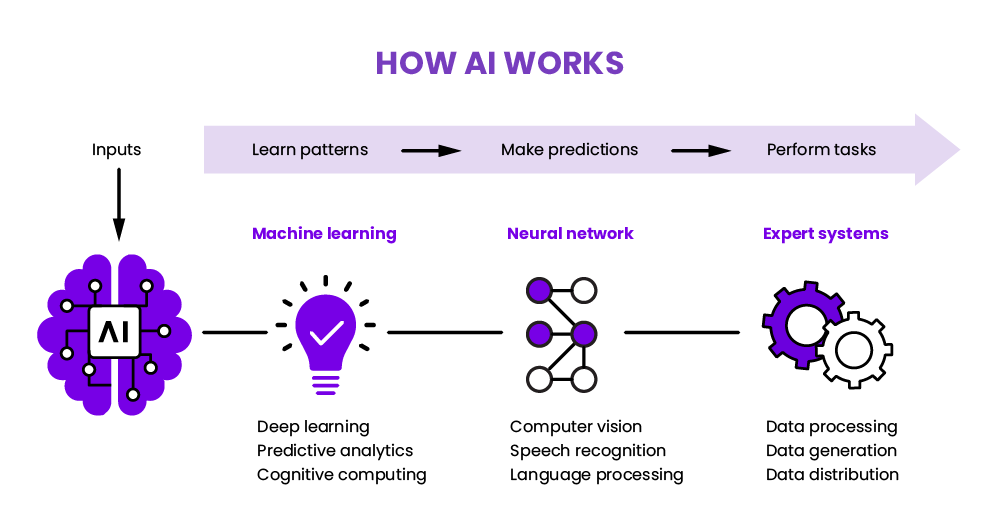
In a recent 2024 article by the American Counseling Association (ACA), their guidelines report that AI “lacks the ability to holistically consider a client’s complex personal history, cultural context, and varied symptoms and factors,” markers human counselors readily examine when providing mental health services, career counseling and educational guidance. Ill-equipped to relate to the symbiotic exchange and experiences of humans, AI instead is based on a data-driven system of attempted exactness. That is to say, AI tries to get it right through trial and error and relevant information available from online databases, research institutions, public records and data manually input by humans. Through an artificial neural network much like the interconnected neural structure of the human brain, AI uses accessible data and progressive learning algorithms (mathematical computations or instructions) in a process of deep learning to adapt, identifying patterns, making predictions, and performing tasks (aka, solving problems).
Advancements in technology continue to address AI’s computer-based limitations to understanding human emotion and communication. A recent study published in the Proceedings of the National Academy of Sciences found that AI-generated messages helped people feel their concerns were ‘heard’, offering promising preliminary research that attempts to solve a familiar human problem. Nevertheless, study participants ultimately rejected the response administered through AI when they realized a robot had provided it. It’s clear that more work needs to be done. In the end, or at least for the time being, human empathy and human experiential learning cannot be replaced with the sterile solutions offered by an artificial, nonhuman intelligence.